

An AI API provides your application with hosted access to an AI model via a standard web request. You send a prompt, the provider runs the model on its own infrastructure, and your app receives tokens back without managing GPUs, model serving, autoscaling, or deployment.
For open-model use cases, the main differences come down to speed, price, model coverage, and deployment control. Some providers focus on low latency, some on raw throughput, some on broad model access, and others on giving teams more control over model deployment.
This guide compares five AI API providers across speed, pricing, use cases, and fit. Each provider can also be routed through the Braintrust Gateway, so teams can test them on the same traffic, log every call, and compare latency, cost, and quality before choosing where to send production traffic.
What an AI API is
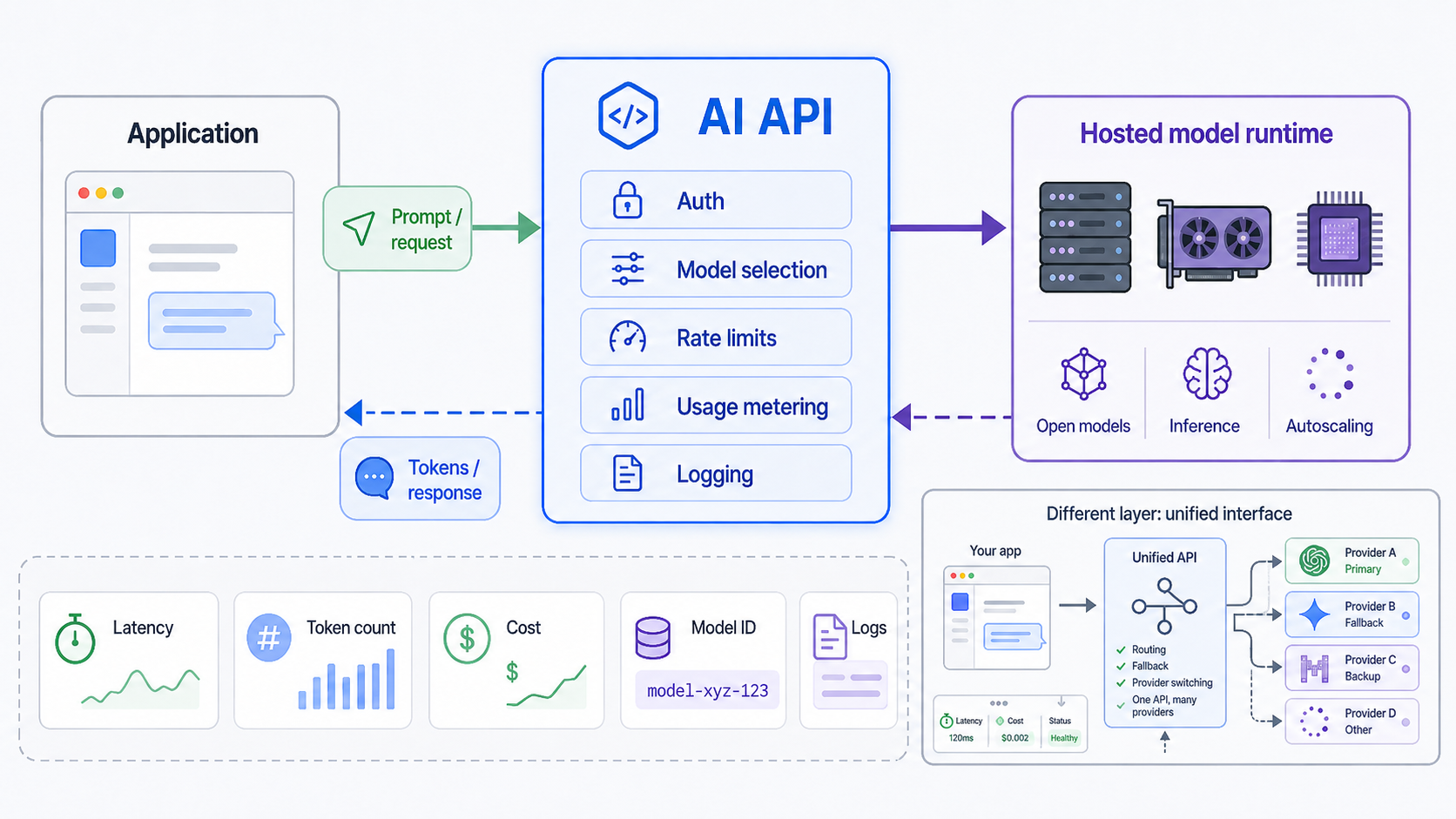
An AI API sits between your application and the hosted model runtime, handling the request path, provider-side inference, and operational metadata such as latency, token count, cost, model ID, and logs.
An AI API is the hosted compute layer your application calls when it needs a model response. The app sends a prompt to an endpoint, the provider authenticates the request, runs the selected model on its own infrastructure, and returns generated tokens without requiring your team to manage GPUs, serving code, scaling, or model deployment.
An AI API is separate from a unified interface layer. The API itself runs the model, while a unified interface sits atop several AI APIs and lets your application switch between providers without rewriting integration code. For the multi-provider setup, see our guide on unified LLM API providers.
Five AI APIs compared on speed and price (2026)
Groq
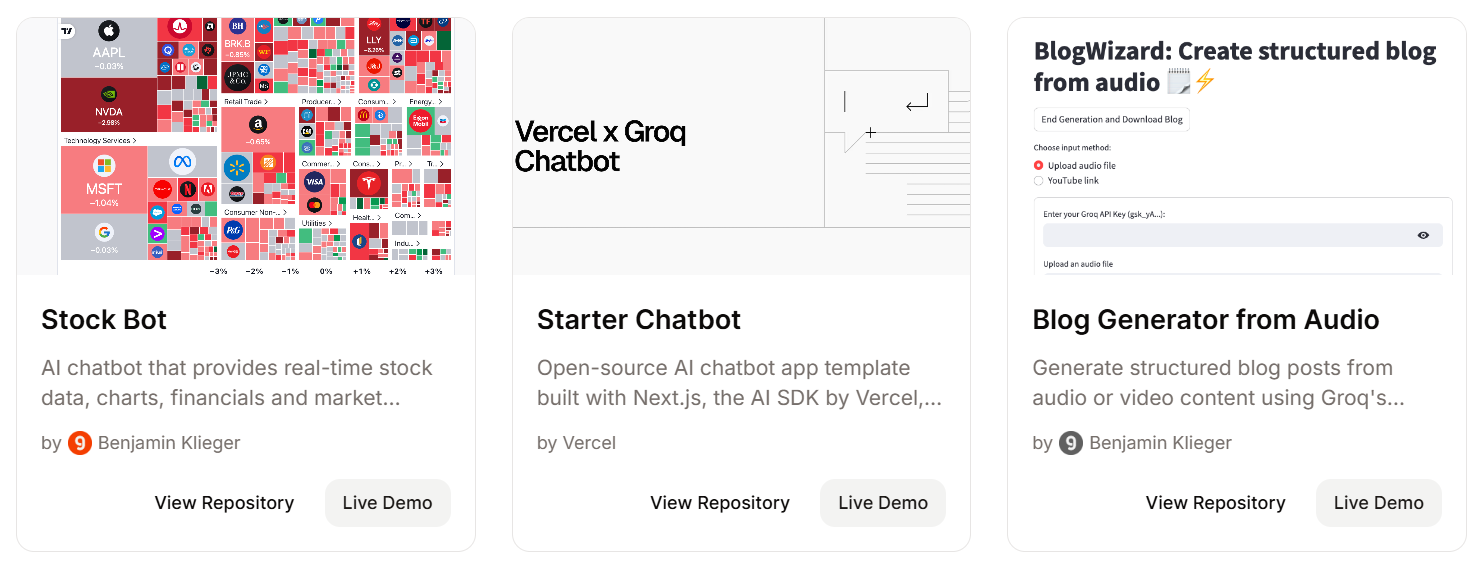
What it is: Groq runs an inference API built on its own custom chip, the Language Processing Unit, or LPU. The chip is designed for sequential token generation, which is the core operation behind language model inference.
Known for: Groq is known for low-latency inference on supported open models. Its model catalog is more focused than broader open-model platforms, but the supported models are served directly on Groq infrastructure.
Commonly used for: Teams building latency-sensitive applications, such as live chat assistants and voice agents, often use Groq because time to first token affects the product experience.
Pricing: Groq charges per token with no monthly minimum, and its free tier needs no credit card. GPT-OSS 120B is currently listed at $0.15 per million input tokens and $0.60 per million output tokens, with batch and cached-input requests billed at lower rates. Check Groq pricing for current rates.
Through Braintrust: Braintrust Gateway can route Groq calls through a single endpoint and log each request.
Cerebras
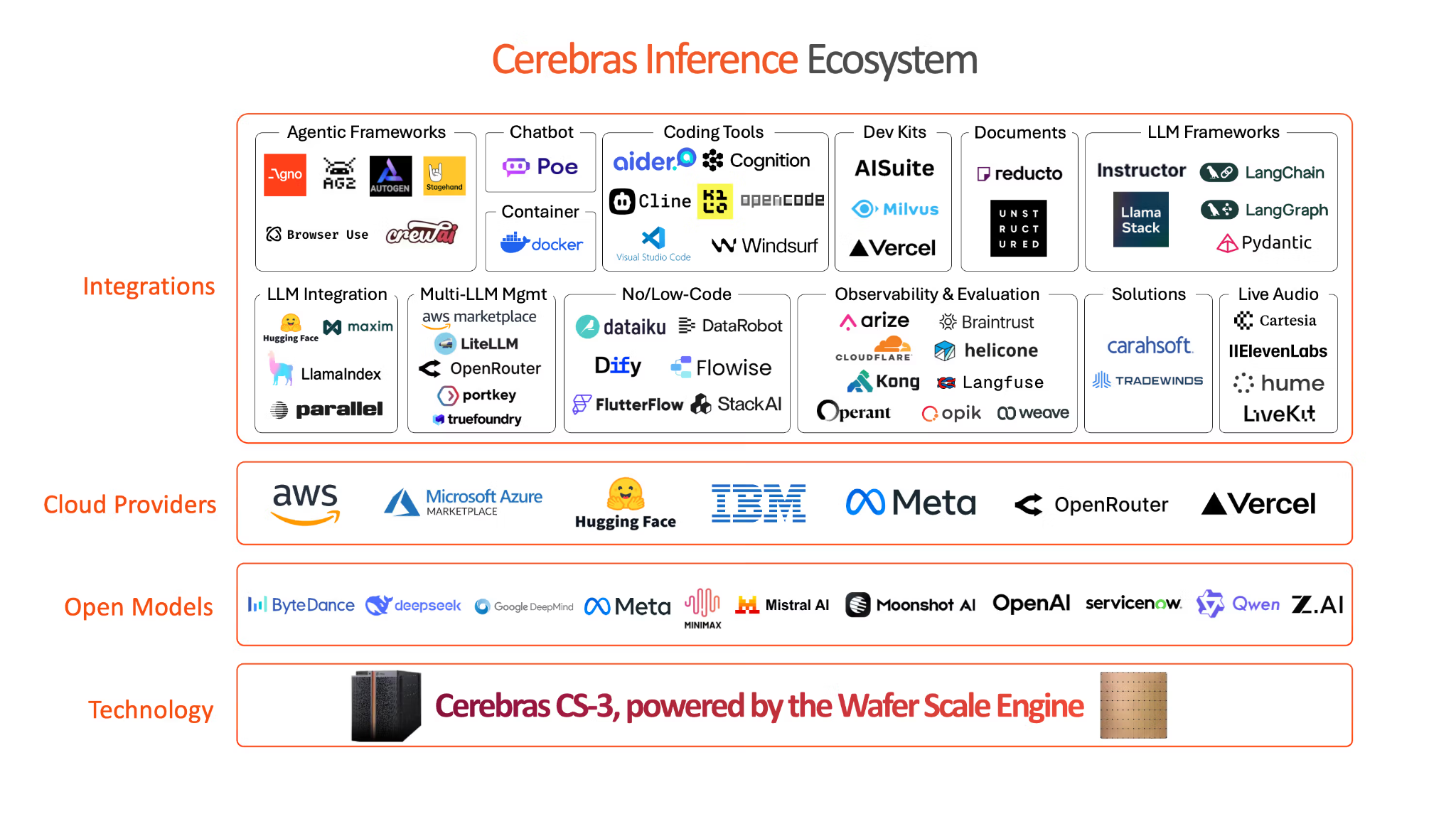
What it is: Cerebras runs an inference API on wafer-scale hardware, where one large chip handles work that usually runs across clusters of smaller accelerators. Its API is OpenAI-compatible, so teams can test it from existing LLM client code.
Known for: Cerebras is known for high token throughput on the open models it supports. Its model catalog is narrower than the broadest inference platforms, but the supported models are served on infrastructure optimized for fast generation.
Commonly used for: Teams running high-volume generation pipelines, real-time applications, and speed-sensitive user experiences often try Cerebras when the supported model catalog fits their use case.
Pricing: Cerebras offers free API access with rate limits, a self-serve Developer tier, and dedicated endpoints for production capacity. GPT-OSS 120B is currently listed at $0.35 per million input tokens and $0.75 per million output tokens. Check Cerebras pricing for current rates.
Through Braintrust: Braintrust Gateway can route Cerebras calls through a single endpoint and log each request.
Fireworks AI
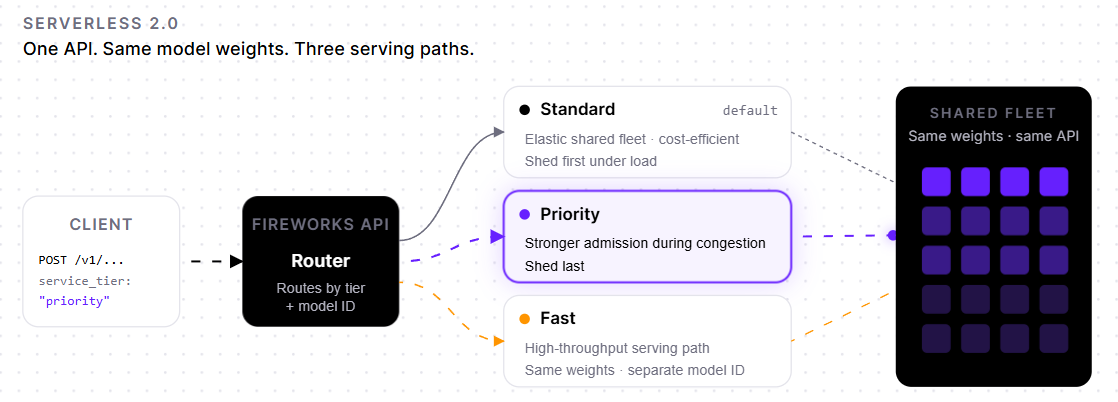
What it is: Fireworks AI runs open models through an optimized software inference stack on GPU infrastructure. It supports serverless inference, fine-tuning, and production deployment for popular open models.
Known for: Fireworks AI is known for managed access to large open models, including Llama, DeepSeek, Qwen, and GPT-OSS families. Its software-based serving stack lets it add new open models quickly as they are released.
Commonly used for: Teams that need fast access to large open models without running their own inference cluster commonly use Fireworks AI. It also supports fine-tuning, so teams can adapt a model and serve it through the same provider.
Pricing: Fireworks AI charges per token for serverless inference. GPT-OSS 120B is currently listed at $0.15 per million input tokens and $0.60 per million output tokens, with cached input and batch inference billed at lower rates. Check Fireworks pricing for current rates.
Through Braintrust: Braintrust Gateway can route Fireworks AI calls through a single endpoint and log each request.
Together AI
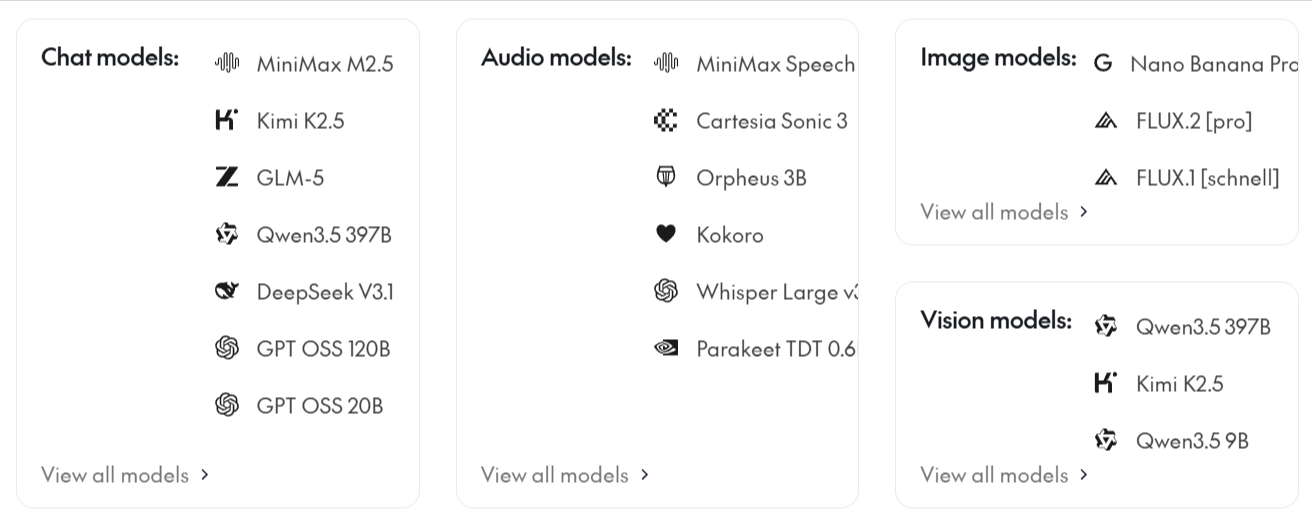
What it is: Together AI is a broad inference platform with serverless per-token access, dedicated endpoints, and fine-tuning support. Its catalog spans text, image, audio, and video models, with a large selection of open model families.
Known for: Together AI is known for its breadth of models across the Llama, Mixtral, DeepSeek, Qwen, and GPT-OSS families. Teams can test many open models, fine-tune supported models, and move from shared serverless usage to reserved capacity.
Commonly used for: Teams that want a wide model catalog, fine-tuning options, and a path from experimentation to dedicated production serving often use Together AI.
Pricing: Together AI charges per token on serverless inference and separately for dedicated endpoints. GPT-OSS 120B is currently listed at $0.15 per million input tokens and $0.60 per million output tokens. Check Together AI pricing for current rates.
Through Braintrust: Braintrust Gateway can route Together AI calls through a single endpoint and log each request.
Baseten
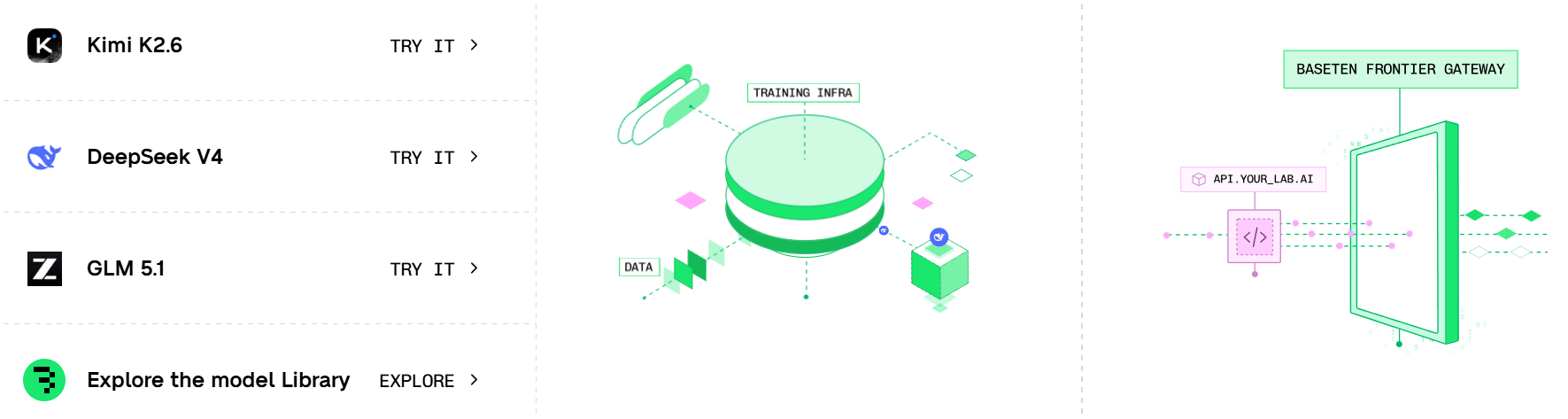
What it is: Baseten is an inference platform for deploying, autoscaling, and serving models on dedicated infrastructure. Teams can use its Model APIs for hosted models or deploy their own models with more control over runtime and scaling behavior.
Known for: Baseten is known for deployment control. It supports dedicated deployments, autoscaling, custom model packaging, and production inference infrastructure for teams that need more control than a shared hosted endpoint provides.
Commonly used for: Teams that want to run a specific open, custom, or specialized model with control over deployment and scaling commonly use Baseten.
Pricing: Baseten charges per token for Model APIs and per compute minute for dedicated deployments. GPT-OSS 120B is currently listed at $0.10 per million input tokens and $0.50 per million output tokens through Model APIs, while dedicated deployment costs depend on the selected hardware and runtime. Check Baseten pricing for current rates.
Through Braintrust: Braintrust Gateway can route Baseten calls through a single endpoint and log each request.
Other AI APIs worth knowing
Replicate lets teams run, fine-tune, and deploy a wide range of open-source and proprietary models through an API. It is useful when you want to test many model types quickly or package your own model for hosted inference. Replicate pricing is usually based on how long a model takes to run, with some models billed by input and output. Check Replicate pricing for current rates.
NVIDIA DGX Cloud Lepton gives developers access to GPU compute across cloud providers and supports deploying AI models as endpoints. It is closer to a compute and deployment layer than a simple hosted open-model API, so it fits teams that need more control over infrastructure and scaling.
Perplexity offers the Sonar API for real-time, search-grounded answers with citations. Unlike the providers above, Perplexity targets web-aware research and Q&A, while the main list focuses on hosted inference for open models. Check Perplexity pricing for current rates.
Each of these can also be routed through the Braintrust Gateway, so teams can log requests and compare latency, cost, and output quality across providers.
AI API feature comparison
The table below compares providers based on the factors that typically affect production fit.
| Dimension | Groq | Cerebras | Fireworks AI | Together AI | Baseten |
|---|---|---|---|---|---|
| Consistent low latency | Yes | Yes | Strong | Strong | Depends on deployment |
| Raw speed on small and mid-size models | Yes | Yes | Strong | Strong | Depends on setup |
| Large open-model serving | Focused catalog | Focused catalog | Yes | Yes | Yes |
| Model breadth | Focused | Focused | Wide | Widest | Open models plus custom deployments |
| Fine-tuning support | No | No | Yes | Yes | Yes |
| Deployment control | Hosted API | Hosted API | Serverless plus dedicated deployments | Serverless plus dedicated endpoints | Full deployment control |
| Reachable and loggable via Braintrust | Yes | Yes | Yes | Yes | Yes |
Speed and price change quickly across models, regions, and provider capacity. Use Artificial Analysis for current side-by-side benchmarks, then confirm final costs on each provider's pricing page before routing production traffic.
AI API pricing compared
Most providers charge by token for hosted inference, while dedicated deployments add infrastructure-based pricing. The table below uses GPT-OSS 120B as the shared reference model.
| Price dimension | Groq | Cerebras | Fireworks AI | Together AI | Baseten |
|---|---|---|---|---|---|
| GPT-OSS 120B input / output per 1M tokens | $0.15 / $0.60 | $0.35 / $0.75 | $0.15 / $0.60 | $0.15 / $0.60 | $0.10 / $0.50 |
| How you pay | Per token | Per token across access tiers | Per token for serverless inference | Per token on serverless, separate pricing for dedicated endpoints | Per token for Model APIs, per compute minute for dedicated deployments |
| Free way to test | Free tier, no card needed | Free API access with rate limits | Starter credits | Signup credits | Starter credits, with no charge while deployments sit idle |
| What drives the bill | Model size and token volume | Model, token volume, and access tier | Model size, token volume, and request type | Model, token volume, and reserved capacity | Model API usage, selected hardware, and runtime |
| Built-in ways to lower cost | Batch and cached-input rates | Higher tiers for production capacity | Cached-input and batch rates | Cached-input rates and dedicated capacity | Scale-to-zero and volume discounts |
Because token prices shift with model choice, cache usage, and traffic volume, treat the numbers above as a snapshot and confirm live rates on each provider's pricing page before routing production traffic.
Matching AI APIs to use cases
None of these providers is better than the others in the abstract. Each one gives you a different starting point, depending on your application requirements.
Groq is a strong starting point for real-time chat, voice agents, and user-facing copilots, where time to first token directly impacts the product experience.
Cerebras fits high-volume generation on supported small and mid-size models, especially when the priority is moving a large number of tokens through the system quickly.
Fireworks AI works well for teams that need managed access to larger open models without having to operate their own inference cluster. It is also useful when inference and fine-tuning must remain in the same environment.
Together AI gives teams the broadest model catalog in this group, along with fine-tuning and dedicated serving options. It is a good fit when the team wants to test several open-model families before settling on one.
Baseten is the better starting point when the model, deployment pattern, or scaling behavior requires more control than a shared-hosted endpoint provides. Teams use it when they want to run a specific open, custom, or specialized model on dedicated infrastructure.
The right provider depends on how your own prompts perform under production-like traffic. You can route the same requests through the Braintrust Gateway, log each call, and compare latency, cost, token usage, and output quality in one place. For the logging workflow, see the Braintrust tracing guide, and for the separate multi-provider interface layer, see the guide on unified LLM API providers.
FAQs: Best AI APIs in 2026
What is the difference between an AI API and a single interface across many models?
An AI API runs the model and returns the response from provider infrastructure. One interface over many models sits above providers and gives your application a consistent way to switch models, compare outputs, or route traffic across vendors. For the multi-provider interface layer, see the guide on unified LLM API providers.
How do I compare AI API providers on my own workload?
Use the same prompts, model size, request volume, and response requirements across every provider you test. Track time to first token, total latency, token usage, cost, error rate, and output quality from the same logging layer, so the comparison reflects your product traffic instead of a generic benchmark.
Which is the cheapest AI API for open models?
The cheapest option depends on the model, token mix, cache usage, batch usage, and traffic volume. Smaller models are usually far cheaper than larger models across all providers, so model selection often changes cost more than the provider name does. Use provider pricing pages and benchmark sources for the exact model you plan to run.
Which AI API is the fastest?
The fastest provider depends on the model, region, request size, and current capacity. Custom hardware providers can perform very well on the models they support, while optimized GPU serving platforms may be stronger for broader model coverage. Test speed with your own prompts before choosing a provider for production.
How do I watch speed and cost across several AI APIs at once?
Route provider calls through one logging layer, then compare latency, token count, model ID, cost, errors, and outputs from the same view. Braintrust Gateway can route calls across these providers and log each request, while Braintrust traces capture the request-level data you need for comparison.